How to Calculate Integrals with Steps
En un coup d'œil
This guide provides a comprehensive overview of integration, covering essential rules from the power rule to the fundamental theorem of calculus. Perfect for students looking for a structured, step-by-step approach to solving indefinite and definite integrals.
Introduction
If you've ever wondered how to calculate integrals, you're not alone. Integrals are one of the core pillars of calculus, used everywhere from physics and engineering to economics and data science. The good news is that once you understand the core rules, solving integrals becomes a structured, repeatable process — not a mystery.
In this guide, we'll walk through the fundamentals of integration, cover the most important rules, and show you how an integral calculator with steps can support your learning journey.
What Is an Integral?
An integral is the mathematical operation that computes the accumulated total of a quantity. If a derivative tells you *how fast* something is changing, an integral tells you *how much* has changed overall. For a deeper dive into the formal definition, you can explore the definition of Riemann Integral on Wolfram MathWorld, which is the gold standard for mathematical reference material.
There are two main types:
- Indefinite integrals — give you a family of functions (antiderivatives), always written with a constant *+ C*
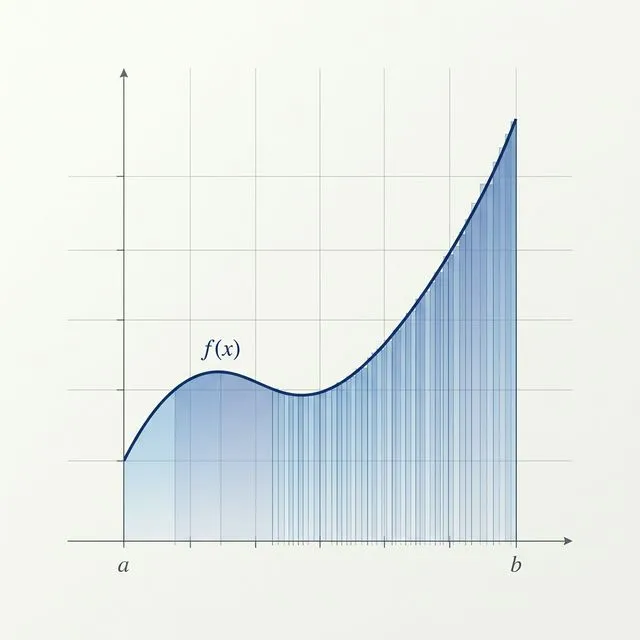
- Definite integrals — give you a specific numerical value, representing the area under a curve between two bounds. If you need to visualize these slopes before integrating, our derivative calculator can help you see the rate of change.
How to Calculate Integrals: The Core Rules
1. The Constant Rule
If you're integrating a constant *c* with respect to *x*:
∫ c dx = c·x + C
Example: ∫ 5 dx = 5x + C
2. The Power Rule
This is the most frequently used rule in integration. For any power of *x* where *n ≠ −1*:
∫ xⁿ dx = xⁿ⁺¹ / (n+1) + C
Step-by-step example — ∫ x³ dx:
1. Identify the exponent: n = 3 2. Add 1 to the exponent: 3 + 1 = 4 3. Divide by the new exponent: x⁴ / 4 4. Add the constant: x⁴/4 + C
3. The Constant Multiple Rule
If a constant is multiplied by a function, you can factor it out:
∫ k·f(x) dx = k · ∫ f(x) dx
Example: ∫ 6x² dx = 6 · ∫ x² dx = 6 · (x³/3) = 2x³ + C
4. The Sum and Difference Rule
You can break a sum or difference into separate integrals:
∫ [f(x) ± g(x)] dx = ∫ f(x) dx ± ∫ g(x) dx
Example: ∫ (x² + 3x) dx = x³/3 + 3x²/2 + C
5. The Natural Logarithm Rule
When *n = −1*, the Power Rule breaks down (division by zero). Instead:
∫ (1/x) dx = ln|x| + C
6. Exponential Functions
∫ eˣ dx = eˣ + C
The exponential function is its own antiderivative — a unique and elegant property.
How to Solve Indefinite Integrals: A Full Example
Let's apply everything above to solve:
∫ (3x² + 2x − 5) dx
Step 1 — Apply the sum rule: Split into three separate integrals.
∫ 3x² dx + ∫ 2x dx − ∫ 5 dx
Step 2 — Apply the constant multiple rule to each term:
3 · ∫ x² dx + 2 · ∫ x dx − 5 · ∫ 1 dx
Step 3 — Apply the Power Rule:
3 · (x³/3) + 2 · (x²/2) − 5x
Step 4 — Simplify:
x³ + x² − 5x + C
This is the complete solution. The + C at the end is essential — it represents the constant of integration, since any constant disappears when differentiated.
Definite Integrals: Adding Bounds
A definite integral evaluates the antiderivative between two points *a* and *b*, using the Fundamental Theorem of Calculus:
∫ₐᵇ f(x) dx = F(b) − F(a)
Example: ∫₀² x² dx
1. Find the antiderivative: F(x) = x³/3 2. Evaluate at b = 2: F(2) = 8/3 3. Evaluate at a = 0: F(0) = 0 4. Subtract: 8/3 − 0 = 8/3 ≈ 2.67
This value represents the exact area under the curve y = x² from x = 0 to x = 2.
Common Mistakes: The Integration "Gotchas"
Even when you've learned how to calculate integrals, it's easy to trip over small details. Here are the most frequent slips:
- The Missing Constant: forgetting `+ C` on indefinite integrals. This isn't just a technicality; it represents the entire "family" of functions that could have produced your result.
- The $1/x$ Trap: Many try to apply the Power Rule to $1/x$ ($x^{-1}$), which would lead to division by zero. Remember: the integral of $1/x$ is always $\ln|x| + C$.
- Ignoring Simplification: Always check if you can algebraically simplify an expression before you start integrating. Re-writing a fraction can turn a hard problem into a series of easier ones.
- Switching Definite Bounds: In definite integrals, always plug the upper limit into the antiderivative first, then subtract the result of the lower limit. Reversing them will flip the sign of your answer!
The Logic: Flipping the Differentiation Switch
To truly grasp how to solve indefinite integrals, you have to see them as the reverse of derivatives. This relationship is the Fundamental Theorem of Calculus. While a derivative breaks a function down to find its instantaneous "slope," an integral gathers those infinite slopes to find the "total" accumulated value.
Think of it as a logical loop: 1. Derivatives take you from *Position* to *Velocity*. 2. Integrals take you from *Velocity* back into *Position*.
This is why we often call an indefinite integral an antiderivative. You are effectively playing a matching game: *"Which original function, when differentiated, would result in this specific result?"*
Integrals in the Real World: Beyond the Classroom
Calculus isn't just marks on a page; it’s the engine behind modern civilization:
- Physics & Energy: Calculating the distance a rocket travels from its acceleration data or finding the work done by a variable force.
- Economics: Finding the "Total Profit" or analyzing how wealth is distributed (the Gini coefficient) by integrating supply and demand curves.
- Technology: Your phone's GPS uses integration to refine its location by accumulating speed over time.
- Architecture: Designing the structural integrity of curved buildings, like the Sydney Opera House, requires precise area and volume calculations.
Moving Toward Mastery
The basic rules are your foundation, but as you grow, you’ll learn the "Art of Integration"—knowing which tool to pull from your kit and when. As you move into more advanced calculus, look out for:
1. U-Substitution: Reversing the Chain Rule. 2. Integration by Parts: Reversing the Product Rule. 3. Partial Fraction Decomposition: Breaking complex fractions into simpler, "bite-sized" pieces.
The Mathsway Advantage: Step-by-Step Clarity
Learning integration is about pattern recognition. Seeing an integral calculator with steps in action helps you visualize these patterns. Instead of just "getting the answer," you see the logical progression—the "why" behind the "how."
Mathsway's tool is crafted to provide this exact clarity, running instantly in your browser to keep your work fast and private. Whether you're a student studying calculus for the first time or refreshing your knowledge before an exam, seeing each step explained clearly makes a real difference in understanding.
Summary
Learning how to calculate integrals is about building familiarity with a small set of core rules:
| Rule | Formula | ||
|---|---|---|---|
| Constant Rule | ∫ c dx = cx + C | ||
| Power Rule | ∫ xⁿ dx = xⁿ⁺¹/(n+1) + C | ||
| Log Rule | ∫ 1/x dx = ln\ | x\ | + C |
| Exponential | ∫ eˣ dx = eˣ + C | ||
| Sum Rule | ∫ (f ± g) dx = ∫ f dx ± ∫ g dx |
Once you internalize these patterns, how to solve indefinite integrals becomes a predictable, step-by-step process. Ready to try it yourself? Use Mathsway's free integral calculator with steps to practice any expression and see every rule explained as it's applied.