When Math Stops Being Scary: The Quiet Role of Digital Tools
At a Glance
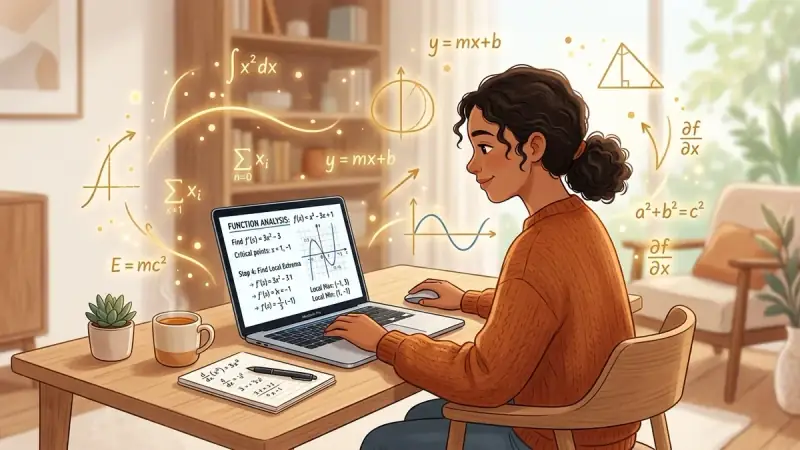
Traditional math instruction moves fast and stacks heavily, leaving many students with lingering anxiety. Digital calculators and step-by-step solvers don't replace thinking — they provide a judgment-free space to fail, understand every step, and build lasting confidence.
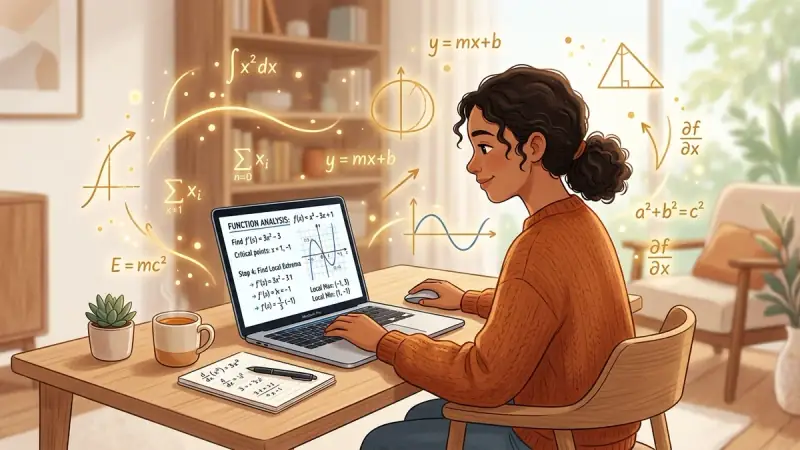
I still remember the exact feeling of staring at a quadratic equation and having absolutely no idea where to even start. Not because I was bad at math, but because the textbook explanation assumed I already understood the part I was stuck on. A lot of students hit that same wall every single day, and honestly, it's one of the main reasons so many people grow up saying "I'm just not a math person." They probably were, at some point. Something just clicked wrong along the way and nobody caught it in time.
That's the real problem traditional math instruction has always had.
The Classroom Can Only Do So Much
Picture a class of thirty students. The teacher explains a concept once, maybe twice if there's time, then moves on because the curriculum has a schedule to keep. If you got it, great. If you didn't, you're now trying to learn tomorrow's lesson on top of a shaky foundation from today. Math is brutal like that — it stacks. Miss one brick and the wall above it starts leaning.
For a long time there wasn't much of a fix for this besides tutoring, which costs money most families don't have lying around, or repeating a grade, which nobody wants. What's changed is that technology has quietly filled that gap. Step-by-step solvers, interactive practice sites, calculators that actually explain themselves instead of just spitting out a number — these things exist now, they're free, and a kid can use them at 11pm the night before a test without anyone judging them for it. Sites like Mathsway have built entire toolkits around exactly this idea.
Answers Aren't the Point. Understanding Is.
Here's the thing a lot of people get wrong about online math tools: they assume it's just a way to cheat, to skip the thinking part. Good tools do the opposite. They show the work. A student punches in a tricky integral, and instead of "the answer is 4x² + C," they see every single step that got them there. That's the difference between memorizing a shortcut and actually understanding what an integral even represents.
You can see this kind of approach in the integral calculator on Mathsway, where a student types in a function and instead of a single isolated number, gets the whole logical chain laid out in front of them. A kid can trace back through it and go "oh, that's where I went wrong" instead of just copying an answer they don't understand.
There's also something people don't talk about enough, which is the anxiety piece. Getting called up to the board and freezing in front of thirty classmates does real damage to a kid's confidence — damage that sticks with people well into adulthood. Peer-reviewed research published in Frontiers in Psychology has found that math-anxious individuals are measurably slower and less accurate at retrieving numerical information from working memory, showing that this isn't just discomfort — it carries a real, documented cognitive cost. A screen doesn't judge you. You can be wrong three times in a row on a laptop and nobody knows but you. That privacy to fail quietly and just try again is worth more than people give it credit for.
Not Every Brain Learns the Same Way
My youngest cousin needs to see a graph before anything makes sense to her. My nephew, on the other hand, just wants to grind through fifty practice problems until the pattern sinks in on its own. Neither approach is wrong, but a single teacher in a single classroom can't realistically cater to both, plus everyone else's learning style, plus stick to a state-mandated pacing guide. Something has to give, and usually it's the kids who learn differently than "average."
This is exactly where good digital tools earn their spot. Take derivatives — a concept that trips up a shocking number of students because the notation looks intimidating even when the underlying idea (how fast is something changing right now) is fairly intuitive. A derivative calculator that breaks the algebra into individual steps can make that notation click in a way a rushed classroom explanation sometimes can't. It's a second try at the same lesson, explained slightly differently, which is often all a stuck student actually needs.
Parents Get Stuck Too
Nobody really talks about this part, but plenty of parents sit down to "help" with homework and quietly realize they haven't touched this material since they were fifteen. Math curriculums shift over the years. Notation changes. Methods change. A parent trying to explain limits to their kid using a method they learned decades ago can end up making things more confusing, not less.
Having somewhere to actually plug in the problem and see it explained properly takes that pressure off. Instead of the classic "just ask your teacher tomorrow" cop-out, a parent can pull up a limit calculator, sit down next to their kid, and figure it out together in real time. It turns a frustrating homework session into something closer to teamwork.
This Isn't Just About Passing Tests
There's a longer-term argument here too. Whatever career a student ends up in — engineering, finance, medicine, doesn't matter — they're going to use digital tools to check their work constantly. That's just how professional math gets done now. Nobody's doing long division by hand at their finance job. Teaching kids to use calculators and solvers responsibly, rather than treating them like contraband, prepares them for how the real working world actually operates.
None of this means the tools should do the thinking for you, though. A student who blindly copies whatever number pops up without engaging with the steps is setting themselves up to fail the second a real test takes that crutch away. Used properly — as a way to check your own reasoning, get unstuck, or see a concept explained a second way — these resources genuinely help. Used lazily, they're just a fancier way to avoid learning anything.
So Where Does That Leave Things
Math doesn't have to be a subject only a handful of "gifted" kids ever really get. Give a struggling student the right explanation, a low-pressure place to mess up and try again, and some patience, and something usually shifts. It might take a week. It might take a semester. But it happens more often than people expect.
Educational technology hasn't replaced teachers, and it shouldn't try to. What it's done is fill in the cracks — the late-night confusion before a test, the homework question a parent can't answer, the concept that just needed one more explanation to finally land. Whether it's the integral calculator, the derivative calculator, or the limit calculator, tools like these are simply part of that toolkit now.