Mathematics in Art: How Geometry, Equations, and Aesthetics Shape Masterpieces
At a Glance
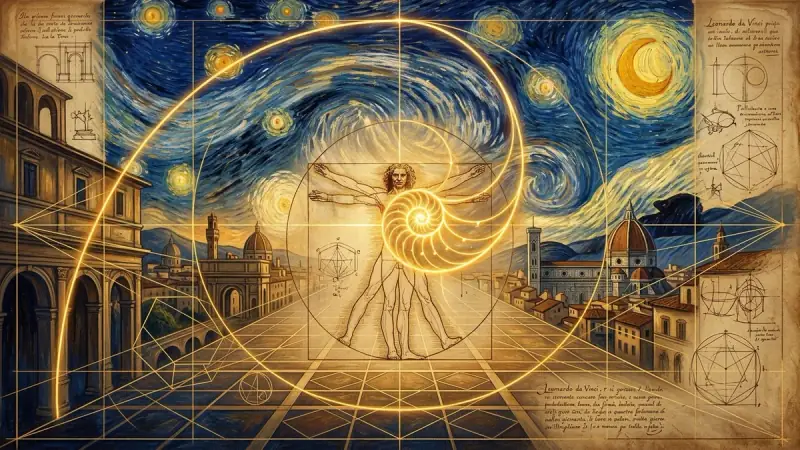
Somewhere along the way, we got sorted into 'math people' or 'art people.' In reality, mathematics is the scaffolding that makes emotion land — from the Golden Ratio in the Renaissance to Kolmogorov turbulence in Van Gogh's Starry Night and Escher's plane symmetry.
Somewhere along the way, most of us got sorted into "math people" or "art people," as if the two were opposites. It's a convenient story, but it falls apart the moment you actually look at art history. Mathematician Edward Frenkel once compared teaching math without art to teaching art class by only ever showing kids how to paint a fence — never a Picasso, never a da Vinci. You'd come away thinking painting is just about covering a surface evenly, and you'd miss the entire point.
In reality, mathematics rarely restricts what an artist can do. More often, it's the scaffolding that makes the emotion land. Symmetry, proportion, perspective — these aren't creativity's enemies, they're some of its oldest tools. When a painter bends a rule, or follows one almost too precisely, the impact usually comes from the viewer sensing that structure without ever naming it. Here's a look at nine places where math and art turn out to be the same conversation — from sacred geometry to the physics of a turbulent sky.
Classical Proportions and Sacred Geometry
Long before anyone talked about "design principles," artists and architects were already leaning on numbers to guide where the eye lands.
The Golden Ratio and Fibonacci Sequence
The Golden Ratio — roughly 1.618 — and its cousin, the Fibonacci sequence (, and so on), show up again and again in nature: in shells, in flower heads, in the spiral arms of galaxies. Artists caught on to this proportion centuries ago and started using it to build compositions that just feel balanced, even when you can't say why. A golden rectangle, split and re-split, traces out a spiral that quietly pulls a viewer's eye through a painting instead of letting it hit a straight line and stop. If you want to play with the underlying math yourself, this limit calculator is a handy way to work through the sequences behind it.
Sacred Geometry Symbols
Beyond the Golden Ratio, a few basic shapes carry meaning that shows up across totally unrelated cultures. Circles tend to stand for wholeness and continuity. Triangles, with their three fixed points, get tied to stability — mind, body, spirit.
| Mathematical Concept | Value / Formula | Historic Artwork / Architecture | Artistic Purpose |
|---|---|---|---|
| Golden Ratio | approx. 1.618 (ratio 1 : 1.618) | Mona Lisa & the Parthenon | Natural visual balance and focal alignment |
| Fibonacci Spiral | The Great Wave off Kanagawa | Guides the eye through curved composition | |
| Sacred Circle | Continuous perimeter | Mandalas, Buddhist Dhamma Wheels | Wholeness, continuity, unity |
| Sacred Triangle | 3 apex points | Egyptian Pyramids, Gothic Cathedrals | Stability, mind-body-spirit symbolism |
Renaissance Realism: Depth on a Flat Surface
The Renaissance is really where math and art stopped being separate conversations. Painters were chasing one hard geometric problem: how do you make a flat wall or canvas look like it has actual depth?
Linear perspective is the answer most of us learned in school without realizing it was math. Architect Filippo Brunelleschi gets credit for formalizing the single vanishing point — lines that converge toward one spot on the horizon, tricking the eye into seeing three dimensions where there's only two. (If you want the more rigorous version of this, MIT OpenCourseWare has a solid breakdown of the underlying calculus.)
Da Vinci took this further with anatomy. His Vitruvian Man is basically a geometry diagram wearing a human costume — a figure inscribed in both a circle and a square, mapping out what Renaissance thinkers considered ideal human proportions.
And then there's Raphael's The School of Athens, where pyramidal and circular structures quietly organize dozens of figures into a scene that somehow still reads as calm and legible. Geometry doing crowd control.
Fractals: Infinite Detail from Simple Rules
A fractal is a shape that keeps repeating itself no matter how far you zoom in. What's wild is how simple the underlying rule usually is — something like the Mandelbrot set () — and yet the result never stops revealing new detail. This derivative calculator is useful if you want to actually work through the math behind recurrences like that instead of just taking it on faith.
Hokusai's Great Wave has this claw-like foam at the crest that echoes the same self-similar shape you'd find in real breaking waves — the small crests looking like miniature versions of the big one.
Jackson Pollock's drip paintings are maybe the strangest example. His 1947 canvases show genuinely fractal patterns, and he got there purely by feel, decades before Benoit Mandelbrot actually put a mathematical name to what fractals were, back in 1975.
You'll find the same math sitting in your produce aisle, too — Romanesco broccoli spirals in a fractal pattern, and something as simple as a Koch snowflake has a fractal dimension that works out to roughly 1.26.
Van Gogh and the Physics of a Turbulent Sky
Starry Night might be the strangest coincidence in art history. Researchers have found that the swirling sky in the painting closely matches how real turbulent fluids actually behave.
There's a number called the Reynolds number that tells you the ratio of inertial to viscous forces in a fluid — once it climbs past around 10,000, flow tends to tip over into turbulence. The Navier-Stokes equations, which physicists use to model exactly that kind of fluid motion, describe how big turbulent eddies break down into smaller and smaller ones. If you want to trace through the integrals involved in that kind of cascading energy model, this integral calculator walks through the steps.
Here's the part that's genuinely eerie: when researchers ran a luminosity analysis on Starry Night, the distribution matched Kolmogorov's mathematical law for turbulence — a law van Gogh obviously never knew existed, but seems to have painted anyway.
And there's a telling contrast if you look at his Self-Portrait with Bandaged Ear, painted while he was medicated. The pipe smoke there drifts up in calm, straight lines — nothing like the chaotic sky he painted during periods of more acute distress.
Symmetry, Tessellations, and Geometry That Bends
M.C. Escher's interlocking tessellations weren't just a knack he had — he actually studied mathematician George Polya's papers on the 17 plane symmetry groups and translated that fairly dry classification system into art that still messes with people's heads today.
Islamic geometric art got there first in a lot of ways, with star polygons and intricate muqarnas patterns built centuries earlier. The 20th century added Penrose tilings to the mix — a pattern that covers an infinite plane without the design ever exactly repeating.
Then there's non-Euclidean geometry, which throws out the rules most of us learned in school. On a sphere, a triangle's angles add up to more than 180 degrees. In hyperbolic space, they add up to less. Artists and mathematicians have used tools like the Poincaré half-plane to actually visualize these spaces, and the results tend to look both alien and strangely organic at once.
Theorems You Can Actually See
Some of the cleanest overlaps between math and art come from theorems that are, literally, visual proofs rather than abstract statements.
Pick's Theorem is a good example — it finds the area of a polygon on a lattice grid just by counting dots:
where is the number of interior points and is the number sitting on the boundary.
There's also a classic visual proof showing that two consecutive triangular numbers always add up to a perfect square — the kind of thing that's much easier to grasp by looking at it than by reading an equation.
Or take the nine-point circle: in any triangle, nine specific points — including the midpoints of each side — all land on a single circle, and the triangle's orthocenter, centroid, and circumcenter always line up perfectly on what's called the Euler line.
Even branding leans on this stuff without most people noticing — Lissajous curves turn up in corporate logos, and rose curves () produce the kind of repeating floral pattern you've probably seen on fabric or wallpaper without ever wondering where it came from.
Tools Worth Trying Yourself
You don't need a physics degree to start noticing this stuff, let alone using it.
On the analog side, something as simple as an angle finder, a straightedge, or a protractor can sharpen how accurately you capture perspective when drawing from life.
Digitally, GeoGebra is free and lets you play with straightedge-and-compass constructions the same way Renaissance artists did by hand. Peter Stampfli also built a kaleidoscope web app that makes hyperbolic and spherical symmetry something you can actually manipulate instead of just reading about.
And honestly, some of the best habits here are just about mindset — controlling pencil pressure for tonal range, not being afraid to use an eraser as a drawing tool rather than a fix-it tool, and keeping a nature journal to start spotting Fibonacci patterns in pinecones and sunflowers on your own.
A Few Common Questions
How is the Golden Ratio actually used in art? > It's a proportion — about 1.618 — that tends to read as aesthetically pleasing when used to frame a composition. Da Vinci leaned on golden rectangles and Fibonacci spirals to structure both the Mona Lisa and the Vitruvian Man.
What's the real connection between Starry Night and physics? > The painting's swirling sky matches how turbulent fluid flow actually behaves, including the way energy cascades from large eddies down to small ones. A luminosity analysis of the painting even lines up with Kolmogorov's mathematical scaling law for turbulence.
What math did Escher actually use? > Plane symmetry groups, tessellations, and hyperbolic geometry — concepts he studied directly from mathematical papers before turning them into his repeating, impossible-looking patterns.
Is there an equation for finding polygon area from grid points? > Yes — Pick's Theorem: , where represents interior points and represents boundary points.