How to Calculate Integrals with Steps
At a Glance
This guide provides a comprehensive overview of integration, covering essential rules from the power rule to the fundamental theorem of calculus. Perfect for students looking for a structured, step-by-step approach to solving indefinite and definite integrals.
Introduction
If you've ever wondered how to calculate integrals, you're not alone. Integrals are one of the core pillars of calculus, used everywhere from physics and engineering to economics and data science. The good news is that once you understand the core rules, solving integrals becomes a structured, repeatable process — not a mystery.
What Is an Integral
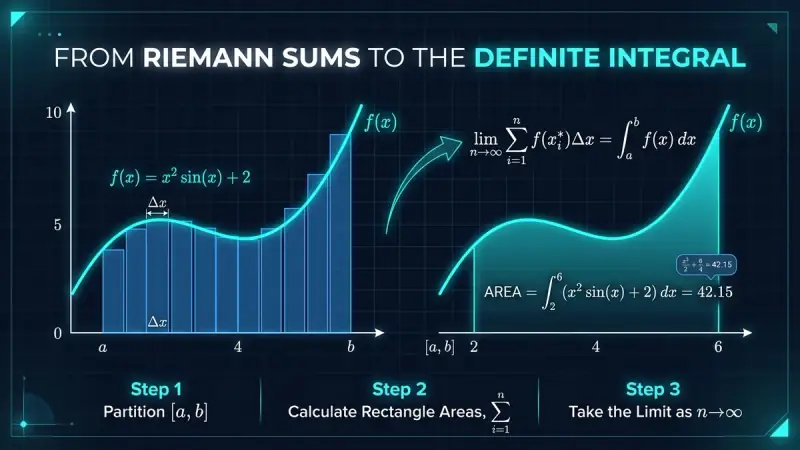
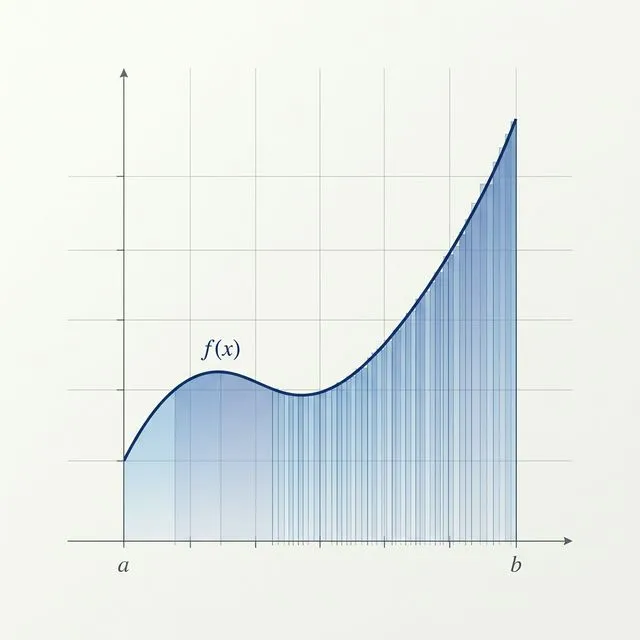
An integral is the mathematical operation that computes the accumulated total of a quantity. If a derivative tells you how fast something is changing, an integral tells you how much has changed overall. Geometrically, taking the integral of a function allows you to find the total area under the curve of that function on a graph.
Core Rules
Before jumping into complex problems, you need to master these 7 essential rules:
- Constant Rule: The integral of a constant \( k \) is \( kx + C \).
- Power Rule: To integrate \( x^n \), add 1 to the exponent and divide by the new exponent: \( \int x^n dx = \frac{x^{n+1}}{n+1} + C \) (for \( n \neq -1 \)).
- Constant Multiple Rule: You can move a constant outside the integral: \( \int kf(x) dx = k \int f(x) dx \).
- Sum/Difference Rule: You can integrate terms separately: \( \int [f(x) \pm g(x)] dx = \int f(x) dx \pm \int g(x) dx \).
- Trigonometric Rules: The integral of \( \cos(x) \) is \( \sin(x) + C \), and the integral of \( \sin(x) \) is \( -\cos(x) + C \).
- Exponential Rules: The integral of \( e^x \) is simply \( e^x + C \).
- U-Substitution: A technique used to undo the chain rule for more complex composite functions.
Full Example
Let's walk through an example. Suppose we want to calculate the integral of \( 3x^2 + 4x - 5 \).
- Apply the Sum/Difference Rule to split the integral:
- \[ \int (3x^2 + 4x - 5) dx = \int 3x^2 dx + \int 4x dx - \int 5 dx \]
- Apply the Constant Multiple Rule to pull out the constants:
- \[ = 3 \int x^2 dx + 4 \int x dx - \int 5 dx \]
- Apply the Power Rule and Constant Rule:
- \[ = 3 \left(\frac{x^3}{3}\right) + 4 \left(\frac{x^2}{2}\right) - 5x + C \]
- Simplify the expression:
- \[ = x^3 + 2x^2 - 5x + C \]
Definite Integrals
While indefinite integrals give you a general function (plus \( C \)), definite integrals give you an exact numerical value, representing the area between two bounds (from \( a \) to \( b \)).
This is solved using the Fundamental Theorem of Calculus: \[ \int_a^b f(x) dx = F(b) - F(a) \] where \( F(x) \) is the antiderivative of \( f(x) \). You simply find the antiderivative, plug in the upper bound \( b \), and subtract the result of plugging in the lower bound \( a \).
Common Mistakes
When learning how to calculate integrals, students often fall into a few traps: - Forgetting the + C: For indefinite integrals, the constant of integration is crucial. Without it, you are missing an entire family of valid solutions. - Applying the Power Rule to \( x^{-1} \): The integral of \( x^{-1} \) (or \( 1/x \)) is not \( x^0/0 \). It is \( \ln|x| + C \). - Messing up negative signs: Especially with trigonometric functions (like the integral of sine being negative cosine), it's easy to flip a sign and ruin the result.
Real World Applications
Why do we calculate integrals? - Physics: Finding the distance a vehicle traveled by integrating its velocity over time. - Economics: Calculating total cost or revenue from marginal cost or marginal revenue. - Engineering: Determining the center of mass, fluid pressure, or work done by a variable force.
Toward Mastery
To truly master integrals, consistency is key: - Memorize the basic rules first. - Practice recognizing when to use advanced techniques like U-Substitution or Integration by Parts. - Always double-check your work by differentiating your answer. If you get back the original function, you did it right!
The Mathsway Advantage
Sometimes, breaking down a complex polynomial or trigonometric function requires a bit of help. That's where our integral calculator comes in handy. It provides step-by-step solutions to guide you through the process, ensuring you not only get the right answer but also understand the methodology behind it.
Summary
Calculating integrals might seem daunting at first, but by understanding the basic concept of area accumulation and mastering rules like the Power Rule and U-Substitution, it becomes highly logical. Keep practicing, watch out for the \( + C \), and leverage digital tools to accelerate your learning.