The Origins of Calculus: From Newton & Leibniz to Modern Online Calculators
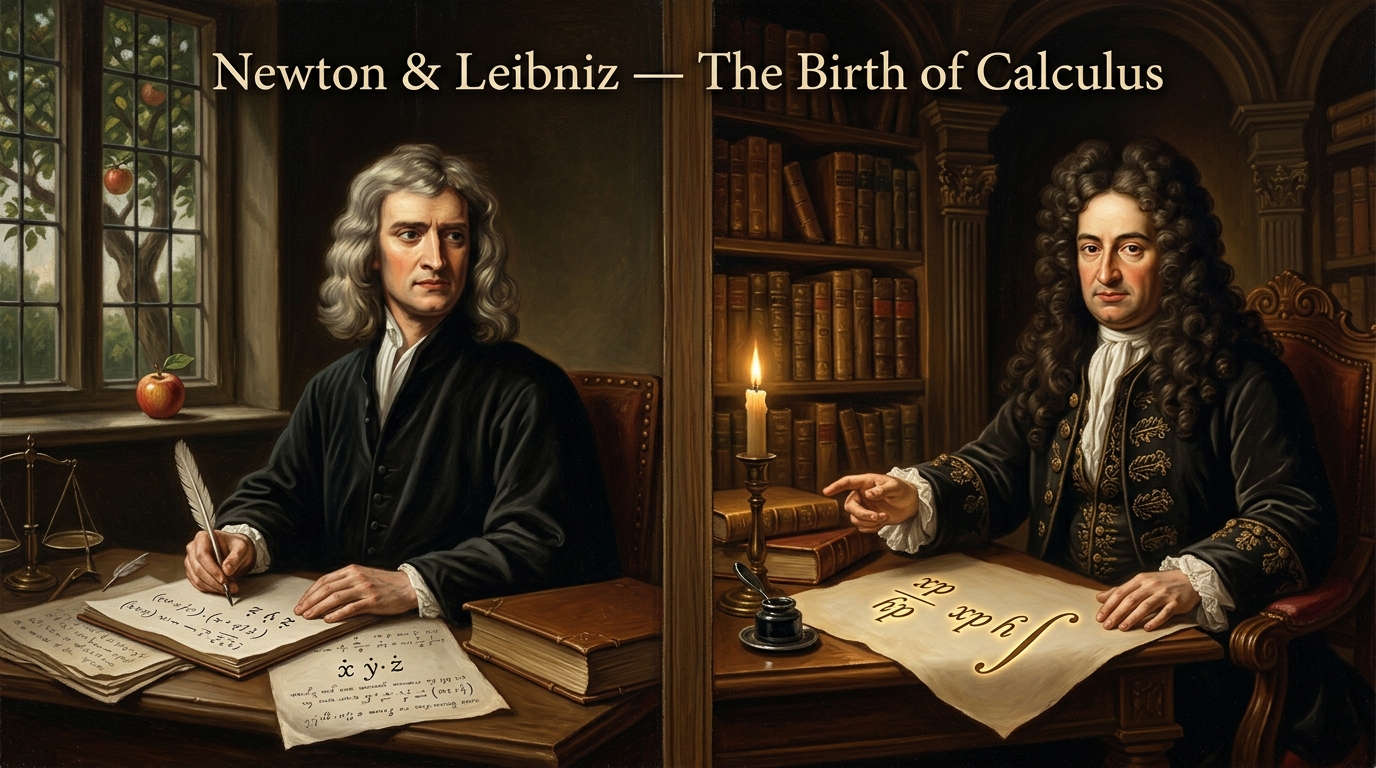
At a Glance
A comprehensive guide to the history of calculus — from Newton's fluxions and Leibniz's elegant notation to the three core pillars of modern mathematics: derivatives, integrals, and limits.
Educational Guide & History
Calculus is widely regarded as one of humanity's greatest intellectual achievements. Developed to model continuous change and motion, it serves as the mathematical foundation for modern physics, engineering, computer science, economics, and data science.
---
1. The Origins of Calculus and the Newton-Leibniz Revolution
In the late 17th century, two mathematical giants independently formulated the core principles of infinitesimal calculus:
- Sir Isaac Newton (1642–1727): Developed the method of "fluxions" and "fluents" around 1665–1666 to solve astronomical mechanics and formulate his universal laws of gravity and motion.
- Gottfried Wilhelm Leibniz (1646–1716): Conceived infinitesimal calculus independently in the 1670s, creating the elegant notation still used today, including the elongated "S" for integration (∫ from Latin summa) and differentials (dx, dy/dx).
While their historic dispute over priority lasted decades, mathematical history recognizes both thinkers as co-inventors. Later mathematicians, including Euler, Lagrange, Cauchy, and Weierstrass, transformed calculus into a rigorous discipline grounded in formal limits and epsilon-delta proofs.
---
2. Understanding the Fundamental Concepts: Integrals, Derivatives & Limits
d/dx — Derivatives
The derivative represents the instantaneous rate of change of a function. Geometrically, it gives the slope of the tangent line to the curve at any given point.
Essential for velocity calculations, optimization, marginal cost analysis, and neural network gradient descent.
∫ — Integrals
Integration is the inverse operation of differentiation. The definite integral calculates the total accumulated quantity, such as the area under a curve or total distance.
Connected to derivatives through the Fundamental Theorem of Calculus: ∫ f'(x) dx = f(x) + C.
lim — Limits
A limit examines the value that a function approaches as the input approaches a specified target. Limits resolve indeterminate forms (0/0, ∞/∞).
The bedrock upon which continuity, derivatives, and Riemann integration are mathematically defined.
---
3. The Critical Role of Modern Online Math Calculators
Historically, solving complex calculus problems required hours of manual algebra and consulting tables. Modern online solvers like Mathsway combine computer algebra systems (CAS) with web technology to provide essential benefits:
- Instant Verification: Students can verify homework immediately and identify errors without waiting.
- Step-by-Step Learning: Solvers display every intermediate rule, reinforcing intuitive comprehension.
- Universal Educational Equity: Free browser-based access ensures advanced tools are available worldwide.
---
Ready to put calculus to work? Try our free calculators:
- Integral Calculator — Compute definite and indefinite integrals with steps
- Derivative Calculator — Differentiate any expression instantly
- Limit Calculator — Evaluate limits including L'Hôpital's rule
- Equation Solver — Solve algebraic and differential equations